
Local Government Act reforms arrive, but key Sandon gaps remain
Date: 07 July 2026
Authors: Tony Raunic - Genuine People
After months of waiting, Victoria’s long-promised local government reforms have finally arrived — almost.
The Allan Labor Government introduced the Local Government Legislation Amendment (Stronger Communities) Bill to the Victorian Parliament on 17 June 2026, delivering a series of proposed changes to the Local Government Act 2020.
The Bill responds to several governance issues that have been building across the sector, including mayoral removal processes, councillor leave arrangements during State election campaigns, standdown provisions, private prosecutions and CEO employment arrangements.
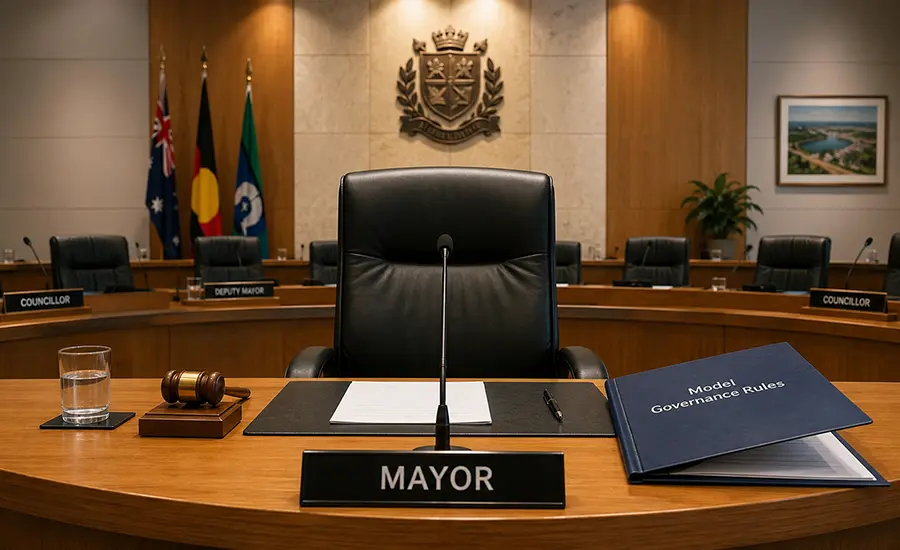
It also points to the long-awaited introduction of Model Governance Rules, although the rules themselves have not yet been released and will still need to go through public consultation.
Model Governance Rules are coming, but not yet here
One of the headline reforms is the introduction of Model Governance Rules, intended to standardise meeting procedures across Victorian councils.
The reform has been expected since the IBAC Operation Sandon Report, which recommended standardised meeting procedures as part of a broader package of integrity reforms.
However, while the Bill refers to Model Governance Rules, it does not include the rules themselves. The sector will need to wait for the proposed rules to be released for public consultation at a later date.
That means council governance officers may be reluctant to make major changes to their existing governance rules in the short term, given those rules could soon be superseded.
Mayors and deputy mayors could be removed mid-term
The Bill proposes changes to the process for declaring the office of mayor or deputy mayor vacant.
At present, section 23 of the Local Government Act 2020 is limited to two-year mayoral terms. The proposed amendment would remove that limitation and create a process for the removal of mayors or deputy mayors during either a one-year or two-year term.
Under the proposed process, a notice of motion would need to be in writing, signed by an absolute majority of councillors and include reasons. The Chief Executive Officer would then be required to circulate the notice and reasons to the mayor or deputy mayor concerned, who would have an opportunity to provide a written response before the council meeting.
That meeting could not be chaired by the mayor or deputy mayor who is the subject of the motion.
The reform appears designed to address recent situations where councils have been unable to force a mayor to stand aside despite a loss of support from councillors.
Clearer rules for councillors running for State Parliament
The Bill also introduces clearer leave of absence requirements for councillors who nominate as candidates for the Victorian Parliament.
From 1 January 2027, a councillor who formally nominates as a State parliamentary candidate will automatically be taken to have been granted candidate leave of absence until the State election.
During that period, the councillor will not be able to act as a councillor, attend council meetings, receive councillor allowances or claim reimbursement for councillor expenses.
A councillor who nominates as a candidate will also be required to notify the council’s CEO in writing.
Additional requirements will apply to mayors and deputy mayors who become State parliamentary candidates. They will be required to step aside from their mayoral or deputy mayoral role earlier, either when they are pre-selected by a political party or, for independent candidates, when they publicly announce their candidacy.
Private prosecutions and councillor standdowns
The Bill proposes changes to councillor standdown provisions where charges have been brought by way of private prosecution.
Under the current legislation, a councillor charged with an offence carrying certain potential penalties is automatically stood down pending the outcome of that process.
The proposed changes would limit the standdown requirement to charges brought by or on behalf of a law enforcement agency. This would exclude private prosecutions from triggering the automatic standdown process.
This is a significant reform for councils, particularly where private prosecutions may be brought on weak or uncertain evidentiary grounds.
Greater certainty where stood down councillors participate in decisions
The Bill also seeks to address practical problems that arise when councils are not immediately aware that a councillor has been charged with an offence that triggers an automatic standdown.
In some cases, a councillor who has been automatically stood down may continue to attend meetings and participate in council decisions before the council becomes aware of the charge.
The proposed amendments would ensure that where a stood down councillor incorrectly participates in a council decision, that procedural defect does not invalidate the decision.
The Bill also introduces a new offence for councillors who fail to notify the CEO and knowingly continue to act as councillors after they have been stood down. The proposed penalty is 120 penalty units.
CEO employment arrangements
The Bill includes proposed reforms to CEO employment arrangements.
These include a requirement for councils to establish a CEO Employment Matters Committee and appoint an independent chairperson.
Many councils already have CEO performance, remuneration or employment committees, but the proposed changes would provide a more consistent statutory framework.
The Bill also foreshadows future regulations dealing with standard form CEO employment contracts and procedural requirements for the appointment and reappointment of CEOs.
Other integrity and governance changes
The Bill contains a range of other amendments, including provisions that clarify existing conflict of interest obligations.
One proposed amendment confirms that a councillor with a conflict of interest must not direct, influence, attempt to influence or discuss the matter with another relevant person who is participating, or expected to participate, in the decision-making process.
In practice, this appears to confirm the existing understanding of the obligations applying to conflicted councillors.
What the Bill does not do
While the Bill introduces a number of important reforms, it does not adopt every major recommendation arising from Operation Sandon.
In particular, it does not introduce a ban on political donations from property developers. Nor does it remove statutory planning powers from elected councillors and replace them with independent determinative planning panels.
Those omissions are significant, particularly given the central role of planning integrity issues in the Operation Sandon Report.
What councils should do now
Councils should closely monitor the progress of the Bill and prepare for further consultation on the proposed Model Governance Rules.
Governance teams may also need to review current governance rules, councillor leave policies, CEO employment committee arrangements and procedures dealing with councillor charges or standdowns.
Although the reforms are not yet law, they provide a clear indication of the direction of travel for Victorian local government governance.
For councils, mayors, councillors and CEOs, the message is simple: reform has arrived, but some of the most important detail is still to come.

Profile