
Supreme Court challenge to mandatory vaccination orders
Category: , New South Wales (NSW), Employment Law
Date: 28 June 2024
Author: Hunt & Hunt - Genuine People
On 15 October 2021, the Supreme Court of NSW dismissed challenges to the vaccination requirements for certain workers imposed under NSW public health orders. The two sets of proceedings in Kassam v Hazzard; Henry v Hazzard [2021] NSWSC 1320 were commenced by 10 plaintiffs who refused to comply with the mandatory vaccination requirements imposed by the:
Date: 28 June 2024
Author: Hunt & Hunt - Genuine People
- Public Health ( Aged Care Facilities) Order 2021 (NSW) (
); - Public Health ( Vaccination of Education and Care Workers) Order 2021 (NSW) (
); and - Public Health (COVID '€“ 19 Additional Restrictions for Delta Outbreak) Order (No 2) (Delta Order No 2).
- Clause 5 imposed restrictions on aged care workers (broadly speaking) from entering or remaining on the premises of a residential aged care facility unless they have received at least 1 dose of a vaccine;
- Clause 6(1) contained a direction from the Minister that on or after 9.00am on 31 October 2021, health practitioners or students "must not enter or remain on the premises of a residential aged care facility unless the person has received 1 dose of a vaccine".
- Clause 4 imposed restrictions on education and care workers (broadly speaking) from entering or remaining in schools and education and care facilities after 8 November 2021, unless they have received 2 doses of a vaccine or have been issued with a medical contraindication certificate.
- Clause 4.23 imposed restrictions on relevant care workers (defined broadly to mean workers in early education and care and disability support) who live or work in an area of concern, from entering or remaining in their place of work unless they received 1 dose of the vaccine or had been issued with a medical contraindication certificate;
- Clause 4.3 imposed similar restrictions on persons from leaving a local government area of concern unless they were an "authorised worker" who has had at least 1 dose of a vaccine or had been issued with a medical contraindication certificate;
- Clause 5.8 imposed further restrictions on a person whose place of residence was in an area of concern from entering or remaining on a construction site in Greater Sydney unless they had:
- Received 2 doses of a vaccine, or
- 1 dose at least 21 days ago or otherwise coupled with a test in the previous 72 hours, or
- A medical contraindication certificate.
- That the Minister did not undertake any real exercise of power in making the order;
- That the order is either outside the power conferred by s 7 of the Public Health Act 2010 (NSW), or represents an unreasonable exercise of that power because of its effects on fundamental rights and freedoms;
- The matter in which the order was made was manifestly unreasonable for reasons beyond its supposed violation of the right of bodily integrity;
- The order was unconstitutional, namely that it was invalid by s 51(xxiiiA) of the Constitution because it had the effect of imposing a form of civil conscription by requiring unvaccinated persons to obtain a vaccine; and
- That the production of vaccination evidence under the order was inconsistent with the federal Australian Immunisation Registered Act 2015 (Cth) (AIRA), which governs the record, use and disclosure of health information, by s 109 of the Constitution.
- The Orders were beyond the scope of s 7 of the Public Health Act 2010 (NSW) on the basis they violated a number of fundamental individual rights and freedoms, including the right to freedom of movement, right to work, right to privacy in relation to collection, use and disclosure of health information contrary to health privacy legislation;[2]
- The Orders were made for an improper purpose, namely that the Minister failed to consider the rights of unvaccinated persons which were engaged by the exercise of his discretion under s 7 of the Public Health Act 2010 (NSW);
- The Orders were administrative decisions which affected the rights, interests and legitimate expectations of the plaintiffs and thus the Minister was obliged to but failed to afford them natural justice and procedural fairness;
- The Minister acted unreasonably where the Orders interfered with fundamental rights; and
- The Orders were unconstitutional and amounted to a form of civil conscription proscribed by s 51(xxiiiA) of the Constitution.
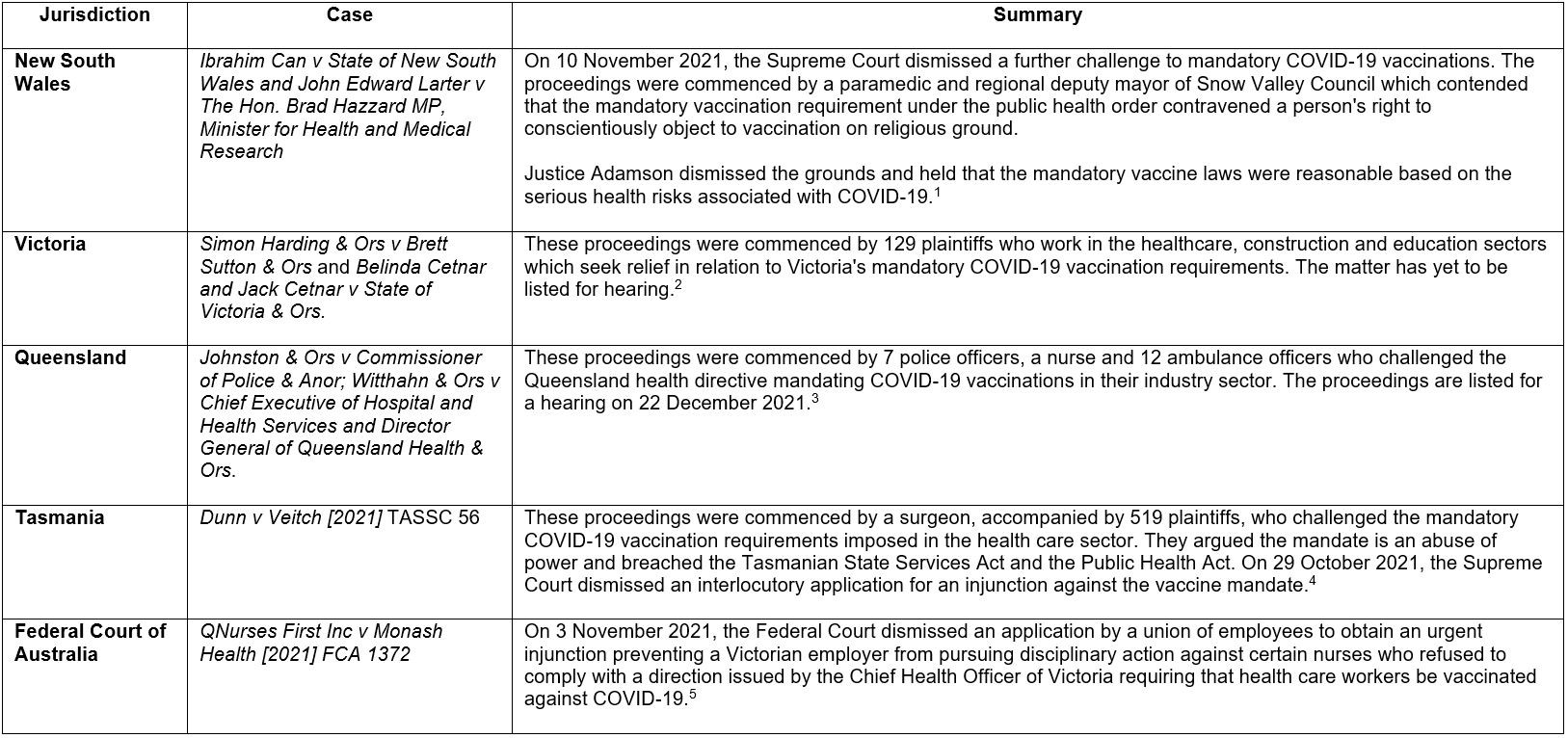 Takeaway
It should be noted that the vaccination requirements imposed under the Orders referred to above have since been repealed and amended. However, the decision serves as a reminder regarding compliance with any existing mandatory vaccination requirements under the current public health orders which apply to certain workers.
Please contact our team for assistance or to discuss how the mandatory vaccination requirements affect you.
[1] Kassam v Hazzard; Henry v Hazzard [2021] NSWSC 1320 [206].
[2] Privacy Act 1998 (Cth); Health Records and Information Privacy Act 2002 (NSW); Australian Immunisation Register Act 2015 (Cth).
[3] Kassam v Hazzard; Henry v Hazzard [2021] NSWSC 1320 at [70].
[4] Jennifer Kimber v Sapphire Coast Community Aged Care [2021] FWCFB at [115] '€“ [129].
[5] Kassam v Hazzard; Henry v Hazzard [2021] NSWSC 1320 at [276].
[6] Ibid [292].
[7] Ibrahim Can v State of New South Wales (2021/00265124); John Edward Larter v The Hon. Brad Hazzard MP, Minister for Health and Medical Research (2021/00259688).
[8] Simon Harding & Ors v Brett Sutton & Ors (S ECI 2021 03931); Belinda Cetnar and Jack Cetnar v State of Victoria & Ors (S ECI 2021 03569).
[9] Johnston & Ors v Commissioner of Police & Anor; Witthahn & Ors v Chief Executive of Hospital and Health Services and Director General of Queensland Health & Ors [2021] QSC 275.
[10] Dunn v Veitch [2021] TASSC 56.
[11] QNurses First Inc v Monash Health [2021] FCA 1372.
Article prepared by: Sarah Cappello, Partner, Joey Tass, Senior Associate, and Margaret Gotsopoulos, Graduate.
Takeaway
It should be noted that the vaccination requirements imposed under the Orders referred to above have since been repealed and amended. However, the decision serves as a reminder regarding compliance with any existing mandatory vaccination requirements under the current public health orders which apply to certain workers.
Please contact our team for assistance or to discuss how the mandatory vaccination requirements affect you.
[1] Kassam v Hazzard; Henry v Hazzard [2021] NSWSC 1320 [206].
[2] Privacy Act 1998 (Cth); Health Records and Information Privacy Act 2002 (NSW); Australian Immunisation Register Act 2015 (Cth).
[3] Kassam v Hazzard; Henry v Hazzard [2021] NSWSC 1320 at [70].
[4] Jennifer Kimber v Sapphire Coast Community Aged Care [2021] FWCFB at [115] '€“ [129].
[5] Kassam v Hazzard; Henry v Hazzard [2021] NSWSC 1320 at [276].
[6] Ibid [292].
[7] Ibrahim Can v State of New South Wales (2021/00265124); John Edward Larter v The Hon. Brad Hazzard MP, Minister for Health and Medical Research (2021/00259688).
[8] Simon Harding & Ors v Brett Sutton & Ors (S ECI 2021 03931); Belinda Cetnar and Jack Cetnar v State of Victoria & Ors (S ECI 2021 03569).
[9] Johnston & Ors v Commissioner of Police & Anor; Witthahn & Ors v Chief Executive of Hospital and Health Services and Director General of Queensland Health & Ors [2021] QSC 275.
[10] Dunn v Veitch [2021] TASSC 56.
[11] QNurses First Inc v Monash Health [2021] FCA 1372.
Article prepared by: Sarah Cappello, Partner, Joey Tass, Senior Associate, and Margaret Gotsopoulos, Graduate.